Enterprise integration is entering a new phase. For more than a decade, API gateways have been the practical centre of gravity for exposing services, enforcing security policies, and observing traffic across microservices and partner APIs. That model still matters, but the “client” on the other side of the gateway is changing. Increasingly, the caller is not a mobile app or a web front end. It is an AI agent planning a multi step task, invoking tools, streaming results, and delegating subtasks to other agents.
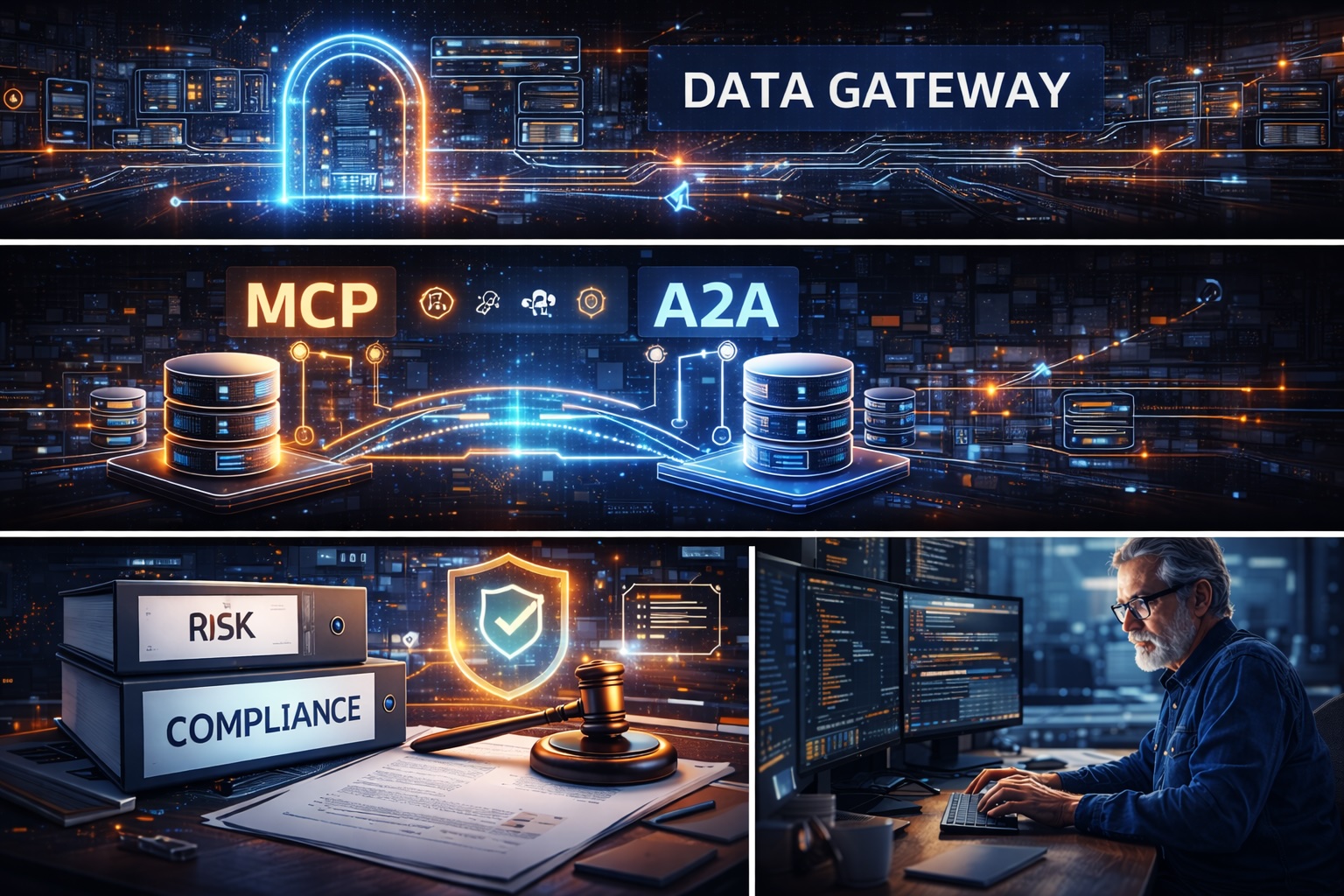
That shift is exactly why the agent gateway concept is gaining momentum: it extends the governance and control strengths of API gateways into agent to tool and agent to agent interactions, including emerging protocols such as Model Context Protocol and Agent to Agent.
What changes when the caller is an agent
A traditional gateway is optimised for stateless request response patterns: validate credentials, apply rate limits, route to a backend, log outcomes, repeat. An agent workflow is different in three important ways:
-
Stateful, multi step interactions
Agents operate across sessions, often chaining tool calls with accumulated context, streaming responses, and intermediate reasoning. Gateways must therefore understand sessions and workflows, not just individual calls. -
Protocol native tool calling and agent messaging
Agent gateways increasingly natively support MCP for tool invocation and A2A for agent coordination, brokering these interactions under central governance rather than leaving them embedded in application code. -
A larger governance surface area
Governance now extends beyond API access to include which agent can call which tool, under what policy, cost limits, and safety constraints, with full auditability of behaviour.
The capability stack that defines an agent gateway
| Capability area | API gateway default | Agent gateway expectation |
|---|---|---|
| Protocol handling | HTTP, REST, gRPC | MCP tool calls, A2A messaging, protocol mediation |
| Identity and access | OAuth, JWT, API keys | Machine identity, zero trust agent and tool boundaries |
| Traffic controls | Rate limits, quotas | Token limits, semantic caching, budget enforcement |
| Discovery | Static endpoints | Dynamic tool and agent catalogues |
| Observability | Request metrics | Step level traces, cost analytics, audit replay |
| Orchestration | Limited | Workflow mediation and tool sequencing |
The point is not that all of this must be deployed at once. It is that the architectural boundary for governance is shifting towards where agent actions occur.
How the major vendors are signalling the shift
Google Apigee: enterprise ready AI gateway capabilities
Google positions Apigee as an AI ready API management platform, adding model abstraction, multicloud model routing, request and response enrichment, semantic caching, token monitoring, and agent connectivity. These features are designed to help organisations control cost, latency, and risk as agents consume and orchestrate AI services.
Kong: MCP governance and production tooling
Kong has been explicit about supporting MCP within its AI Gateway, including MCP based tool discovery via its developer portal, alongside observability and governance for tools, prompts, and workflows. Kong also places strong emphasis on machine identity for AI agents and autonomous systems, aligning agent security with existing zero trust patterns.
Gravitee: agent management as a platform layer
Gravitee frames the transition as AI agent management, covering agent gateways, agent catalogues, and tool servers. It highlights governance of agent to agent communication using A2A, as well as authentication, rate limiting, monitoring, and discovery as first class concerns for agent ecosystems.
Tyk: governance agents and distributed synchronisation
Tyk takes a distributed approach, using deployable governance agents that synchronise API and policy inventories back to a central hub over secure channels. This reflects real world hybrid estates and supports a gradual evolution towards agent aware governance without assuming a single centralised runtime.
What executives and architects should focus on
Four themes consistently emerge when organisations move beyond experimentation:
-
Tool boundary design and permissions
Per tool RBAC and clear scoping are essential to prevent uncontrolled agent behaviour. -
Cost governance that can be enforced
Token budgets, caching strategies, and routing policies must be part of integration architecture, not just model configuration. -
Traceability for risk and compliance
Multi step audit trails and replayable execution histories are required when agents influence operational or financial outcomes. -
Alignment with platform engineering
Policies, configurations, and agent gateway behaviour need to integrate cleanly with infrastructure as code and DevSecOps practices.
If there is one lesson learned early, it is that retrofitting governance after agents are in production is far harder than establishing it upfront.
Questions to ask your API gateway experts
1. How do you govern agent to tool and agent to agent interactions at runtime?
Agent support is not about exposing tools, it is about controlling behaviour during execution. Without runtime governance, multi step agent workflows quickly become opaque and risky.
Listen for
- Native support for MCP and A2A with runtime policy enforcement
- Per agent and per tool authorisation that persists across sessions
2. How do you provide observability and auditability across multi step agent workflows?
Once agents reason and act across multiple steps, traditional API logging is insufficient. Organisations need visibility that supports operational assurance, investigation, and compliance.
Listen for
- End to end tracing across reasoning, tool calls, and responses
- Replayable execution and audit trails
3. How do you enforce cost, usage, and safety limits for agents in production?
Listen for
- Token and budget enforcement per agent and per tool
- Prompt and response filtering with policy driven guardrails
4. How does your agent support integrate with existing API, DevSecOps, and platform engineering practices?
Listen for
- Infrastructure as code and GitOps compatibility
- Alignment with existing API gateway and IAM investments
Most organisations will evolve their existing API gateways rather than replace them. The practical move is to assess which agent gateway capabilities are required now, such as MCP support, machine identity, cost controls, and deep observability, and which can follow later. Framing agent gateways as the next evolution of API management keeps control with architecture and platform teams, while still enabling rapid agent adoption.
References
-
Google Cloud – Apigee AI and API Management
https://cloud.google.com/solutions/apigee-ai -
Kong – Press releases and AI Gateway announcements
https://konghq.com/company/press-room/press-release -
Gravitee – AI Agent Management Platform
https://www.gravitee.io/platform/ai-agent-management -
Tyk – Agent Management and Governance
https://tyk.io/docs/tyk-governance/agent-management