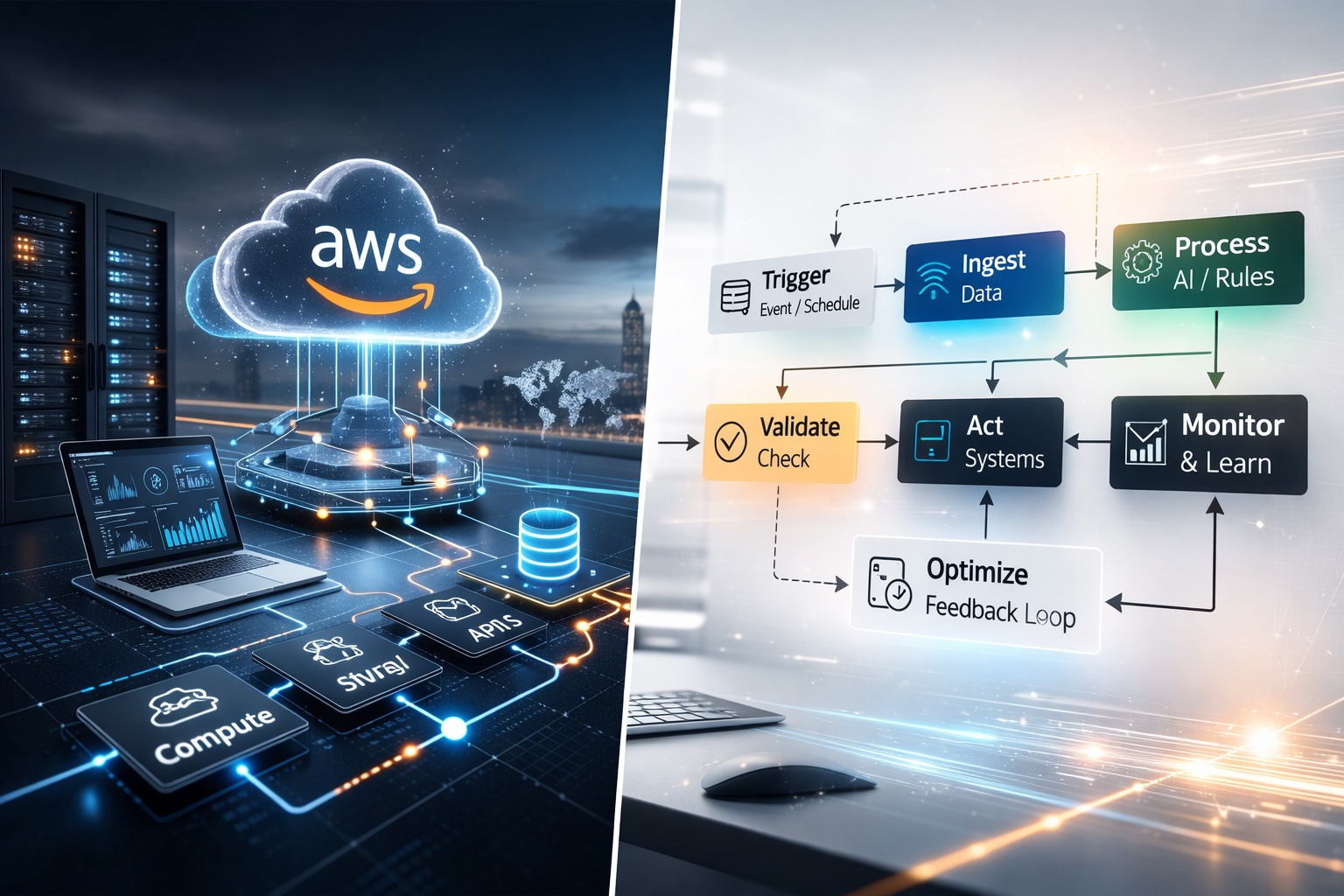

There is a definition of agentic AI circulating inside most organisations right now, and it is the wrong one. The idea that agentic AI means a human asks a question, a large language model answers, and something useful happens — that describes a conversational AI interface. It does not describe an agentic system.
The distinction carries real consequences for architecture, governance, workforce design, and competitive positioning.
The Definition Most People Get Wrong
The word "agent" has been applied so broadly to AI tooling that its engineering meaning has blurred. A single LLM responding to a prompt is not an agent in any meaningful operational sense. Agentic AI requires multiple agents and an orchestration layer working in concert.
The analogy holds closely. In a team, a manager does not perform every specialist task — they decompose the objective, assign work, validate outputs, and escalate when something falls outside policy. An orchestrator agent does exactly that: it plans, delegates to specialist agents, checks results, and escalates to a human when confidence thresholds are not met.
How the Orchestration Model Works
Agentic architecture mirrors how high-functioning organisations already operate. A conversational agent handles the customer-facing interaction. Behind it, specialist agents execute domain-specific tasks in parallel or in sequence, passing results back to the orchestrator, which synthesises and responds.
| Layer | Role | Human equivalent |
|---|---|---|
| Conversational agent | Handles intent, collects context, manages dialogue | Customer-facing relationship manager |
| Orchestrator agent | Plans, delegates, validates, escalates | Senior manager or programme director |
| Specialist agents | Execute domain tasks (research, eligibility, risk) | Subject matter experts |
| Control agents | Monitor, audit, enforce guardrails in real time | Risk, compliance, and governance functions |
| Data / tool layer | APIs, databases, external systems | Information systems and operational infrastructure |
In a banking context, a customer asking about a new product initiates a chain: the conversational agent recognises the intent, the orchestrator delegates to a product agent, a credit-eligibility agent, and a regulatory-suitability agent. Each returns a result. The orchestrator integrates those results and the conversational agent presents a coherent, personalised response — without the customer seeing any of the machinery.
Where Agentic AI Is Already Being Applied
Research and Analysis
Agentic systems are particularly well suited to research tasks that span multiple data sources with different structures, provenance, and reliability. Structured data — formatted, schema-bound records — can be processed with high confidence. Unstructured data — articles, reports, correspondence — requires interpretation, bias assessment, and contextualisation.
Where a human analyst would consume both types to form a view, agentic systems can deploy dedicated agents for each data type. A manager agent then synthesises their outputs into a consolidated conclusion, flagging areas of low confidence or conflicting signals for human review.
The result is research at a scale and consistency that a human team cannot match, with the human remaining responsible for the final decision.
Financial Services: Personalised Wealth Management
The banking sector provides one of the clearest illustrations of what agentic AI makes possible that the current model does not. Banks have largely operated from the same structural playbook since the 1970s. The dominant service model — provide money when needed, offer standard products — is reaching its limits.
The next model is fundamentally different: understand the customer's full financial circumstances and proactively grow their wealth. That requires synthesising data across income, expenditure, assets, life events, market conditions, and regulatory context — continuously, at scale, for every customer.
That synthesis is achievable with agentic systems. It requires not better chatbots, but an architecture of specialist agents, orchestrated around a single customer objective, supported by real-time data access and governance guardrails.
Pensions: Responsible Transformation at Scale
A pensions provider serving hundreds of thousands of members represents a high-stakes deployment context. Every investment in technology is drawn from member funds. Every decision affects real people's retirement outcomes.
Responsible deployment in this environment begins at trustee board level. A governance structure — an AI Council, analogous to a remuneration committee — evaluates proposed use cases before implementation. Each use case is assessed for risk, required controls, and appropriate oversight.
That initial assessment becomes a blueprint. Subsequent use cases that follow the same pattern can be evaluated faster, creating lean governance that scales. A parallel set of control agents monitors live deployments continuously, checking for behavioural drift, hallucination, and compliance. Dashboards give human decision-makers the operational visibility they need without requiring them to interrogate every agent interaction.
Cross-functional Decision Making
Before agentic systems, organisational decision-making was largely siloed. The financial crime expert knew financial crime. The product manager knew product performance. The treasury function knew liquidity. Synthesising those perspectives required meetings, documents, and time.
An orchestrated multi-agent system can produce a cross-functional view on demand — drawing from specialist agents that each hold domain depth — and present integrated analysis to a single decision-maker who no longer needs to be expert in every domain.
This creates a new challenge: the human receiving that synthesis must be capable of critically evaluating an integrated conclusion they could not previously have constructed themselves. That requires upskilling, but in a different direction than most organisations currently plan for.
The Architecture Challenge No One Plans For
Software engineering disciplines that have served organisations for decades need material revision before they are fit for agentic AI. The assumptions that underpin conventional testing, release management, and operational monitoring do not hold.
Real-time Testing in Production
Because the variables affecting model behaviour are outside the development team's control, testing cannot end at release. A customer-facing agentic system must be tested continuously in production — evaluating response quality, checking for hallucination introduction, and monitoring against defined thresholds.
When a threshold is breached, the system must be capable of either switching to an alternative model, routing to human handling, or triggering a business continuity protocol. The alternative — allowing hallucination to propagate to customers — is operationally and reputationally untenable.
Self-healing and Adaptive Architecture
Agentic systems need to build testing and self-healing into their runtime, not as a bolt-on but as a design principle. That means:
- Confidence scoring on every agent output before it passes downstream
- Automated fallback routing when confidence falls below threshold
- Structured logging of state transitions for audit and forensic review
- Policy-as-code enforcement on every inter-agent transaction
The tooling for this exists. The organisational discipline to deploy it consistently — and to fund it as core infrastructure rather than treat it as optional — is what most organisations currently lack.
Span of Control: From 7 People to 1,000 Agents
A capable human manager might effectively oversee seven direct reports. As organisations deploy hundreds or thousands of agents, the management and oversight challenge grows by orders of magnitude.
The solution is to match the scale of execution with an equivalent scale of control. Control agents — purpose-built to monitor, validate, and govern other agents — must run alongside every execution layer. Risk functions, security functions, and compliance functions each need their agentic equivalents, not as replacements for human oversight, but as the infrastructure that makes human oversight tractable at agent scale.
Managing by escalation — defining precisely what conditions trigger human review — becomes the fundamental design principle.
Governance at Scale
The governance model that works for traditional software does not scale to agentic AI. A risk and controls review process designed around human-authored code cannot process thousands of agent interactions per second.
| Governance layer | Traditional approach | Agentic approach |
|---|---|---|
| Use case approval | Ad hoc sign-off | AI Council with standardised risk assessment framework |
| Implementation blueprint | Project-by-project design | Reusable blueprint derived from first approved use case |
| Runtime monitoring | Periodic audits | Continuous control agents with live dashboards |
| Escalation | Manual exception handling | Automated thresholds triggering tiered human review |
| Compliance evidence | Document-based audit trails | Structured log output from every agent transaction |
| Model performance | Point-in-time evaluation | Continuous production testing with automated alerting |
The Workforce Transformation
The shape and face of roles across legal, financial, risk, and technology functions is changing. The question is not whether this will happen. The question is whether organisations are designing the transition or just experiencing it.
The impact on workforce structure is not primarily about job elimination. It is about role transformation — and that transformation is more demanding than most workforce planning currently acknowledges.
| Function | Current primary activity | Emerging primary activity |
|---|---|---|
| Financial crime | Manual investigation of individual cases | Oversight of agent-driven pattern detection and escalation management |
| Legal / compliance | Research, document review, advisory | Evaluating agent-generated analysis, prompt and policy design |
| Data engineering | Building domain models, managing lineage | Designing ontologies, governing agent data access, managing agent-readable schemas |
| Data analysis | Tracking lineage, producing reports | Reviewing agent-synthesised insights, validating conclusions at decision point |
| Human resources | Managing individual performance | Defining performance frameworks for non-human workers, cost modelling for agent vs offshore decisions |
| Risk | Reviewing controls on fixed code | Building and supervising control agent architectures, managing continuous compliance |
The data engineering transformation deserves particular attention. Engineers who have spent careers building domain models and following data lineage manually are being asked to shift to dynamic ontology design — a fundamentally different cognitive model. Agents will follow data lineage. Engineers need to design the systems that make that traceable, auditable, and correct. The professional identity shift is significant, and it takes time.
A PwC and City UK report found that 75% of financial services firms and 82% of lawyers reported using AI primarily for efficiency and process automation rather than value creation.1 The implication is that most current adoption is in the wrong lane. The competitive advantage comes from the value creation layer — and that requires agentic architectures, not automation of existing workflows.
Cost, Access, and the Build Reality
There is an assumption circulating in business commentary that agentic AI will democratise access to capability — that small businesses will be able to deploy the equivalent of large specialist teams at low cost.
The current reality is more constrained.
The parallel to early digital platform adoption is instructive. When enterprise software platforms proliferated in the 2000s, many organisations chose to build rather than configure. They accumulated technical debt that constrained them for a decade. Agentic AI is following the same pattern — with the added complexity that model variability, infrastructure dependency, and governance requirements make the build surface substantially larger.
The near-term path to broader access runs through the major cloud and platform providers. When Azure, AWS, and Google Cloud operationalise agentic capabilities as managed services with built-in governance, the access economics change. Until then, the organisations that can absorb the architecture investment are large, well-resourced, and typically in financial services, healthcare, and professional services.23
Mindset and the Culture of Acceleration
The strategic planning cycle that worked in 2015 — three-to-five year strategies, annual reviews, waterfall delivery — is incompatible with agentic AI's development velocity. An agentic strategy has a shelf life of approximately twelve months. It is reshaped quarterly by value outcomes, workforce adoption data, and model capability changes.
Organisations running AI transformation programmes are reporting an unexpected second-order effect. Clients who moved through fourteen-week transformation sprints at high velocity found themselves questioning why their normal business operations moved so slowly. The discipline and decision-making speed developed inside a transformation programme began transferring to day-to-day execution.
That transfer is worth designing for. The cultural by-product of agentic transformation — faster decision cycles, tolerance for iteration, comfort with measurable outcomes — may be as strategically valuable as the technology itself.
| Mindset shift | From | To |
|---|---|---|
| Strategy horizon | 3-5 year fixed plan | 12-month adaptive roadmap, quarterly reshaping |
| Innovation origin | Top-down mandates | Citizen-led experimentation with top-down ambition |
| Success metric | Process efficiency | Value creation and client outcome |
| Risk posture | Avoid the new | Manage the risk of not moving |
| AI investment framing | Cost and productivity | Competitive differentiation and GDP-level opportunity |
Mark Benioff's observation that CEOs will no longer lead all-human workforces is accurate — but the more precise framing is that executives will lead hybrid workforces comprising humans and agents, and the management disciplines for each are fundamentally different.4
The Consistency Argument
One counterintuitive benefit of well-governed agentic AI is the consistency it introduces into service delivery. Human service, whatever its individual quality, varies. Different expertise levels, different interpretations of policy, different customer experiences depending on who answers the call.
A well-designed agentic system applies the same policy, the same knowledge, and the same ethical constraints every time. That consistency — standardised service quality at scale, with documented decision rationale for every interaction — represents something the human workforce model structurally cannot deliver.
The governance investment required to achieve that consistency is substantial. The outcome is a service architecture that is more auditable, more equitable, and more scalable than what preceded it.
A Note on Responsibility
Every account of agentic AI deployment that has proceeded well shares a common feature: the responsible AI framework was built before the agents were built, not retrofitted afterwards.
That framework covers use-case evaluation, governance committee structure, risk and control blueprinting, continuous monitoring architecture, and human escalation protocol. It also covers the harder question: what is this organisation trying to achieve for the people it serves?
The pensions provider does not deploy agentic AI because it is technically interesting. It deploys it because the alternative — maintaining the current investment decision process with the current workforce at the current scale — means pensioners receive less than they should. The ethical imperative runs in both directions.