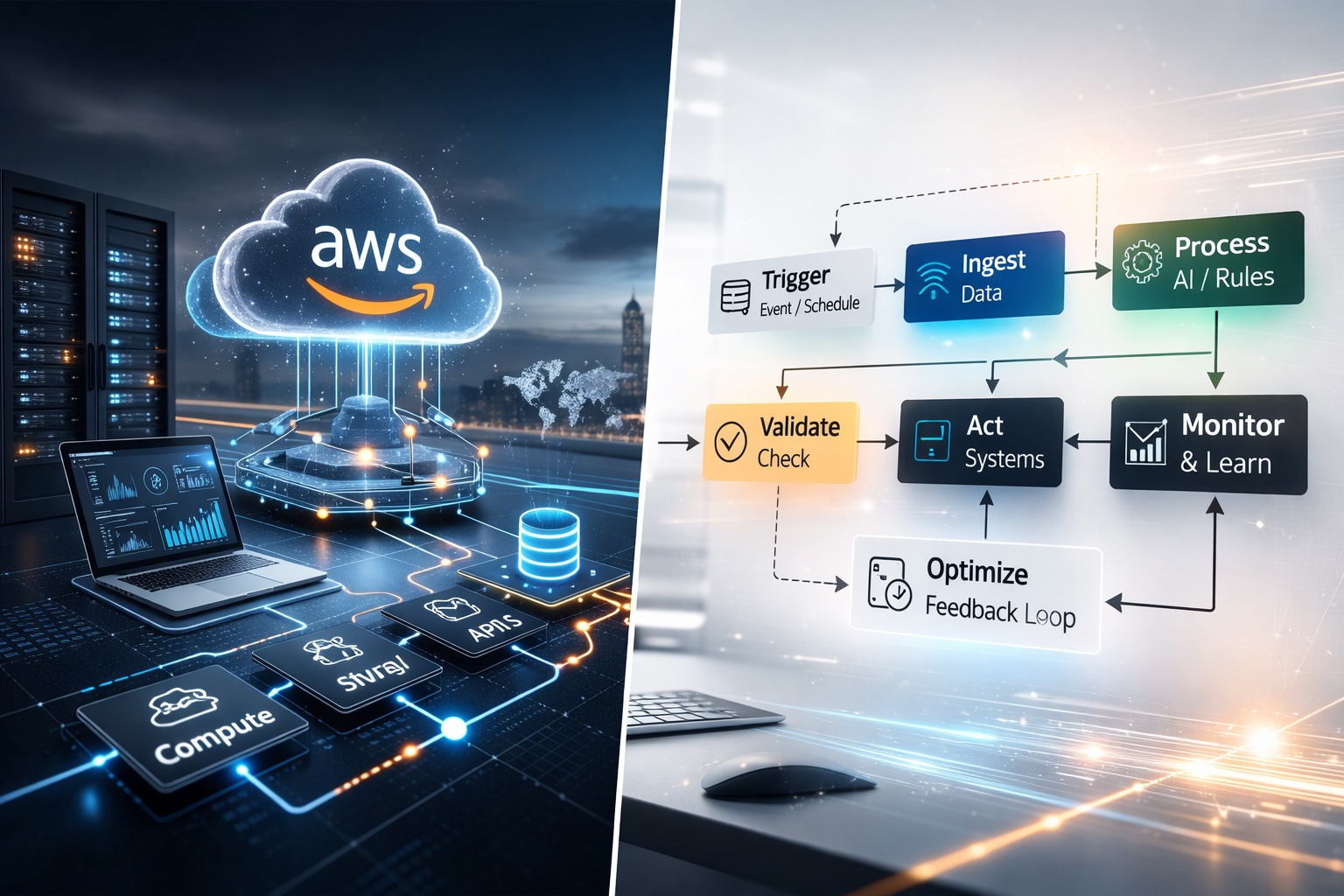

Agentic orchestration is the discipline of coordinating multiple AI agents, tools, and data systems so they can complete complex tasks reliably. Instead of one model answering one question, orchestration manages a full workflow: planning, delegation, execution, validation, escalation, and audit.
If that sounds familiar, it should. The progression looks a lot like how autonomy evolves in cars.
BMW and the wider automotive industry describe automation as a maturity curve from assisted driving to full autonomy. The same framing is useful for enterprise agent systems, where the question is not "does it work once?" but "can it operate safely at scale?"12
What Agentic Orchestration Actually Does
At a practical level, orchestration handles five core jobs:
- Task decomposition: breaking a business request into smaller executable steps
- Role assignment: selecting which agent or service should do each step
- Control flow: deciding sequence, parallelism, retries, and fallbacks
- Guardrails: enforcing policy, permissions, compliance, and quality thresholds
- Observability: logging state transitions, outputs, decisions, and exceptions
Without orchestration, agent systems often become fragile demos. With orchestration, they become operational systems.
A Simple Comparison Model: BMW's Five Levels and Agentic Maturity
BMW's driverless automation narrative is often presented in five levels (from assisted to fully autonomous). For AI teams, this is a useful analogy.13
| BMW automation level | Vehicle behavior | Agentic orchestration equivalent | Human role |
|---|---|---|---|
| Level 1: Driver Assistance | Car can assist steering or speed in limited situations | Single agent assists a user in one step (for example, draft summary + one tool call) | Human leads every decision |
| Level 2: Partial Automation | Car can control steering and speed, but driver constantly supervises | Multi-step workflows execute automatically, but every critical action needs explicit approval | Human supervises continuously |
| Level 3: Conditional Automation | Car drives in specific conditions and requests takeover when needed | Agents run end-to-end in defined domains with confidence checks and escalation triggers | Human intervenes on exceptions |
| Level 4: High Automation | Car drives itself in geofenced domains without constant driver attention | Orchestrated multi-agent systems run autonomously in bounded business contexts with policy engines and runtime governance | Human monitors outcomes, not each action |
| Level 5: Full Automation | Car operates everywhere without driver intervention | Fully autonomous cross-domain orchestration with self-optimizing planning, robust memory, and universal policy compliance | Human sets goals and strategy only |
The level descriptions above align with BMW's published five-level explainer and the SAE J3016 automation taxonomy used across the industry.14
Why This Analogy Helps Teams
Many organizations incorrectly jump from Level 1 prototypes to Level 4 expectations. They expect autonomous operations from systems that still need constant prompting and manual correction.
Using a staged maturity model helps teams:
- set realistic rollout expectations
- design governance proportional to autonomy
- align architecture choices with actual risk tolerance
- measure progress with clear operational milestones
In short, it turns vague "agent strategy" talk into an engineering roadmap.
Technical Markers for Each Stage
If you want to know your current stage, check for these markers:
- Level 1-2 posture: prompt chaining, ad hoc tool use, low policy enforcement, weak tracing
- Level 3 posture: workflow engine, deterministic checkpoints, approval gates, structured exception handling
- Level 4 posture: policy-as-code, continuous evaluation, memory/state management, observability tied to SLAs
- Level 5 posture: adaptive planning across domains, formal verification for safety-critical actions, autonomous optimization loops
Most enterprise deployments today are between Level 2 and Level 3.
The Core Insight
Autonomy is not a model feature. It is a systems property.
BMW did not reach higher levels of vehicle automation by adding only better sensors; it required integrated control systems, safety engineering, fallback logic, and regulatory alignment. Agentic orchestration follows the same pattern.15
If your architecture cannot explain who made a decision, why it was made, what constraints were applied, and how to recover when things fail, you do not yet have high autonomy. You have automation theater.
Where to Start
A pragmatic starting path for most teams is:
- Define one narrow domain where failure impact is controlled
- Implement orchestration with explicit state transitions and audit logs
- Add policy gates before any external side effects
- Introduce confidence-based escalation to humans
- Expand scope only after reliability and governance metrics are stable
That path will not feel flashy, but it is how reliable autonomy is built.
The same lesson from driverless systems applies directly to AI systems: maturity beats hype.
Footnotes
-
BMW Group. "The Road to Autonomous Driving at BMW Group." ↩ ↩2 ↩3 ↩4
-
SAE International. "Taxonomy and Definitions for Terms Related to Driving Automation Systems for On-Road Motor Vehicles (J3016)." ↩
-
BMW.com. "Autonomous driving: 5 steps to the self-driving car." ↩
-
SAE International. "Levels of Driving Automation Visual Chart (J3016)." ↩
-
NHTSA. "Levels of Automation." ↩