
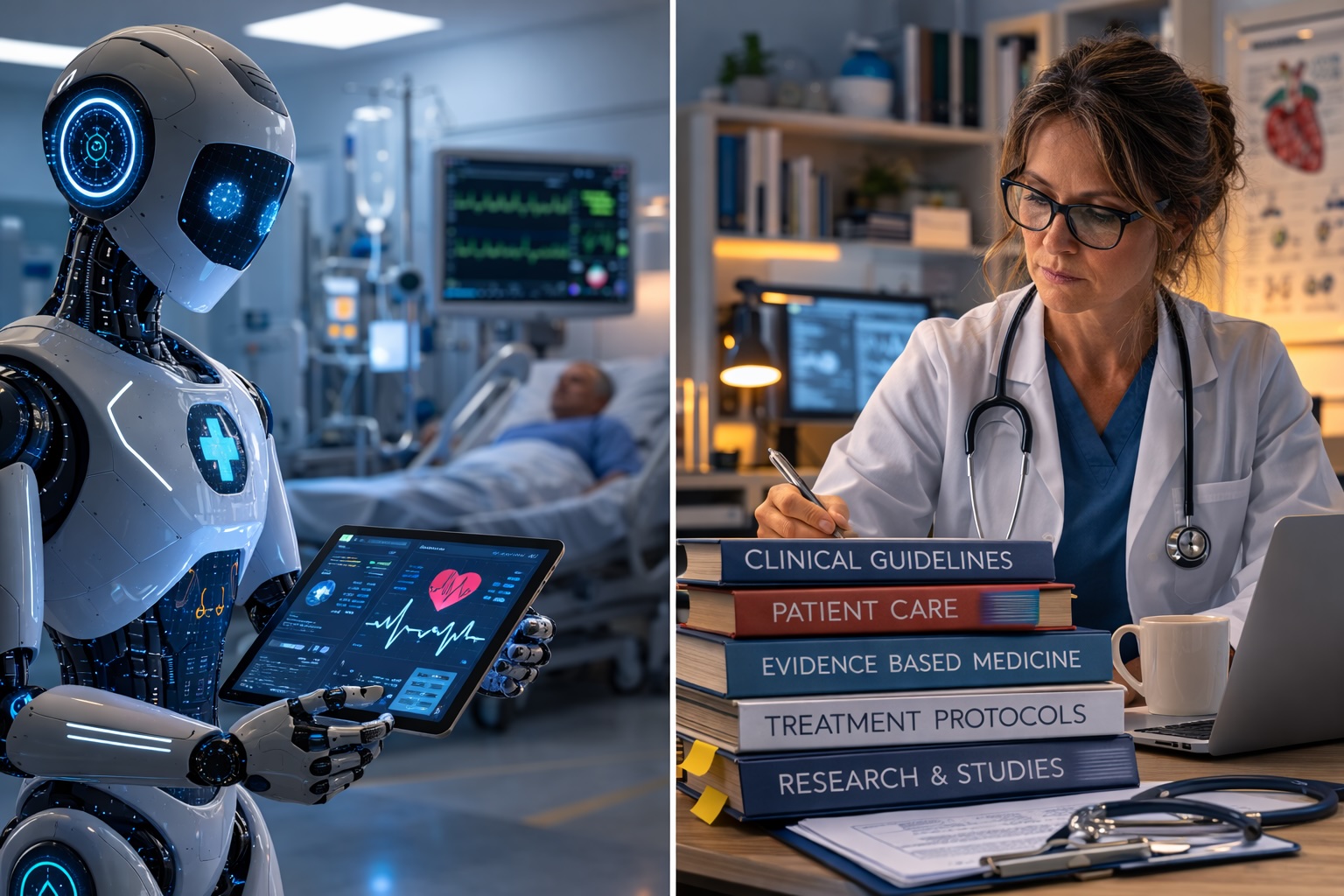
Are we at the beginning of a "software defined care" era, or is this simply another wave of digital health optimism? The question matters because something fundamental is shifting in how care is planned, delivered, and improved. This shift is not about replacing clinicians or reducing healthcare to code. It is about software becoming the primary coordination layer for care decisions, operational flow, and learning at scale.
"Software defined care" describes a model where clinical and operational decisions are increasingly shaped, triggered, and supported by software systems that continuously learn from vast bodies of evidence and real world data. In this model, software does not just record activity after the fact. It actively participates in how care is delivered, how workflows adapt, and how resources are allocated in real time.
For decades, healthcare software has focused on documentation, billing, and reporting. The new frontier is decisional and operational software. This includes agentic services that can assess context, weigh options, and recommend or trigger actions. It includes automation that removes administrative friction. It includes workflows that adapt dynamically rather than forcing staff to work around rigid systems.
A key driver of this shift is the maturity of large language models that have been trained on millions of healthcare references, research papers, clinical guidelines, and case studies. These models bring a form of statistical memory that no individual clinician can match. They do not replace judgment, but they dramatically expand the accessible knowledge base at the point of care.
Agentic services play a central role. An agentic system can monitor patient context, detect when predefined criteria are met, and initiate appropriate actions. This might include proposing reflex lab orders when certain clinical thresholds are crossed, alerting teams to emerging risks, or coordinating downstream tasks across departments. The system does not act blindly. It acts within guardrails defined by clinical governance and policy.
Administrative automation is another major component. Prior authorisations, referrals, appointment scheduling, discharge paperwork, and follow up communications consume enormous amounts of staff time. Automating these processes does not reduce care quality. It increases the time available for direct patient interaction. In a software defined care model, administration becomes a background process rather than a dominant workload.
Workflow automation extends this further. Instead of static pathways, workflows become responsive. A delay in imaging can automatically re sequence downstream activities. A change in patient status can trigger a revised care plan. Capacity constraints can be surfaced early rather than discovered too late. Software becomes the conductor that keeps the system in rhythm.
Reflex orders for labs and diagnostics illustrate the efficiency gains clearly. In many settings, clinicians already follow well established rules for when certain tests should be ordered. Encoding these rules into software reduces delay and variation. It also ensures that routine decisions are applied consistently, while still allowing clinicians to intervene when nuance is required.
This raises an uncomfortable but necessary question. In the future, will more decisions be shaped by a doctor with ten years of experience, or by an LLM trained on ten million books and case studies? The honest answer is that it will be both. The clinician brings context, accountability, and human judgment. The model brings breadth, recall, and pattern recognition at a scale no human can achieve. Software defined care is about combining these strengths rather than choosing between them.
Three cornerstones underpin this emerging model.
The first cornerstone is evidence at scale.
Decisions are informed by continuously updated bodies of knowledge that include guidelines, outcomes data, and real world practice patterns. Software ensures that this evidence is available at the moment decisions are made, not buried in journals or static protocols.
The second cornerstone is agentic orchestration.
Care delivery is coordinated by intelligent services that understand goals, constraints, and dependencies. These agents do not replace teams. They support them by managing complexity, sequencing actions, and highlighting trade offs in real time.
The third cornerstone is human governance and trust.
Software defined care only works if clinicians trust the systems and retain meaningful control. Transparency, auditability, and explainability are essential. Decisions must be understandable, challengeable, and aligned with professional accountability.
Software defined care is not a distant future concept.
Elements of it are already appearing across healthcare systems, often quietly and incrementally. The real question is not whether it will arrive, but how intentionally it will be designed. If done well, it offers a path to more consistent, efficient, and humane care by allowing software to handle the routine and predictable, while people focus on the complex and profoundly human aspects of medicine.