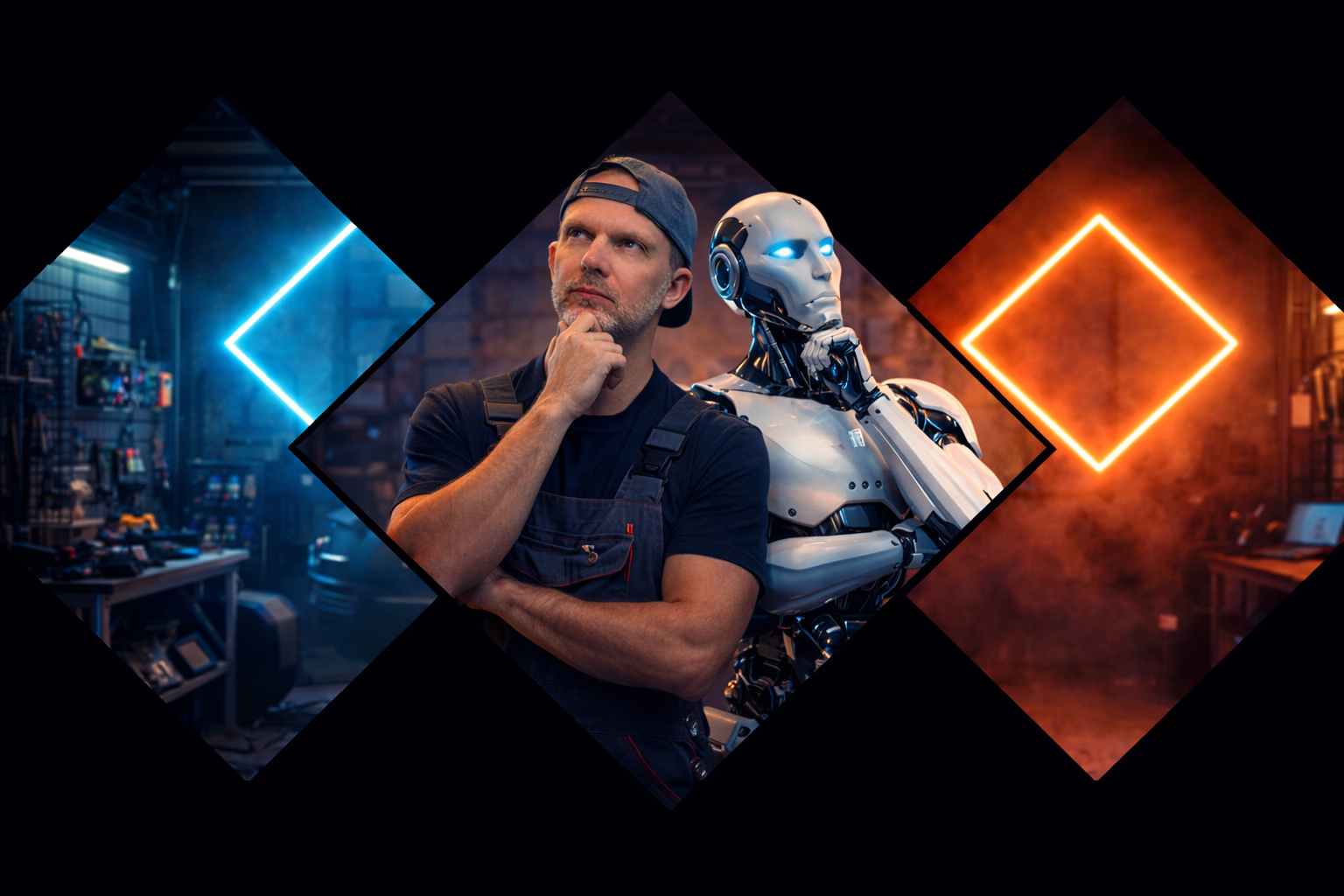
This morning it was a flickering neon strip in the garage. There was a faint buzz, an occasional strobe effect, and just enough inconsistency to make it irritating rather than urgent. The sort of problem you feel you should be able to solve.
So I did what most of us now do. I took a photo, asked AI, and within seconds had a confident answer. Likely ballast failure. It even explained what a ballast was, how it worked, and what needed replacing.
Which is when I realised something slightly uncomfortable.
I had no idea what a ballast actually was. I had always dealt with the old setup. When a tube flickered, you replaced the starter. Simple, visible, and reassuringly mechanical. This was something else entirely.
The Illusion of Knowing
Armed with a diagnosis, I opened the fitting expecting a quick fix. Instead, I found a sealed unit, labelled and wired in a way that immediately felt less familiar. AI had given me the answer, but it had not given me the instinct for what I was looking at.
On the screen, everything made sense. The explanation was clear, the steps were logical, and the outcome felt achievable. In reality, it was different. The wires, the layout, the small variations that never show up in diagrams all introduced hesitation.
The Gap Between Knowing and Doing
This is where the gap becomes obvious. There is a difference between understanding a process and being able to carry it out with confidence. One is cognitive. The other is physical, situational, and built over time.
A trained electrician would open that fitting and immediately recognise the setup. They would not need to interpret each step. They would not second guess the wiring. They would not pause to check whether something looked right. They would simply do it.
That confidence is not explained. It is accumulated.
AI as a Diagnostic Layer
AI is exceptionally good at compressing knowledge. It can identify faults, explain systems, and guide decisions in a way that feels almost complete. It removes the uncertainty of not knowing what the problem is.
But it stops just short of execution.
It does not give you the muscle memory of handling components. It does not give you the pattern recognition that comes from seeing the same issue dozens of times. It does not give you the quiet certainty that something is correct without needing to double check.
A Wider Pattern
This is not about lighting. It is about something broader.
We are optimising for people who can:
- Diagnose problems quickly
- Ask precise questions
- Navigate complex information
At the same time, there is less emphasis on the people who can:
- Apply that knowledge in the real world
- Work through imperfect conditions
- Deliver outcomes with their hands
The balance is shifting, and it is subtle enough that we rarely notice it.
A Quiet Realisation
Standing there with the fitting open, I had everything I needed in theory. The diagnosis was correct. The explanation was clear. The steps were available.
What I lacked was the confidence to execute.
Not because the task was especially complex, but because I had never done it before. There is a difference between following instructions and knowing what you are doing. That difference becomes very obvious the moment something matters.
The Value of Specialists
The person who replaces that ballast will not need to ask AI. They will not need to interpret the situation step by step. They will rely on something far more valuable.
Experience.
Years of seeing similar problems, making small adjustments, and developing an instinct for what works. That kind of capability does not scale through explanation. It scales through practice.
A Small Problem, A Larger Signal
A flickering light is a minor inconvenience. It is also a useful signal.
AI is making us incredibly effective at understanding problems. It is raising the baseline of what we can diagnose and discuss. That is a genuine step forward.
At the same time, the ability to act on that understanding remains rooted in human skill, repetition, and judgement.
The Practical Detail
For reference, the fitting used an electronic ballast rather than the older starter based setup I was familiar with. That small shift in technology was enough to move the task from familiar to uncertain.
And that is the point.
The knowledge was available instantly. The execution was not.
Somewhere between those two sits a category of skill that is becoming quietly more valuable.
Not because it is new.
Because fewer people are practising it.