
Agentic systems are moving beyond prompt driven responses into something far more structured and deliberate. They observe, reason, act, and refine. At the centre of this loop sits memory. Not as a passive store, but as an active component that shapes behaviour, context, and outcomes over time.
In enterprise environments, especially those dealing with operational intelligence, memory design becomes a defining factor in whether an agent behaves like a novelty or a reliable system.
The Layers of Memory in Agentic Systems
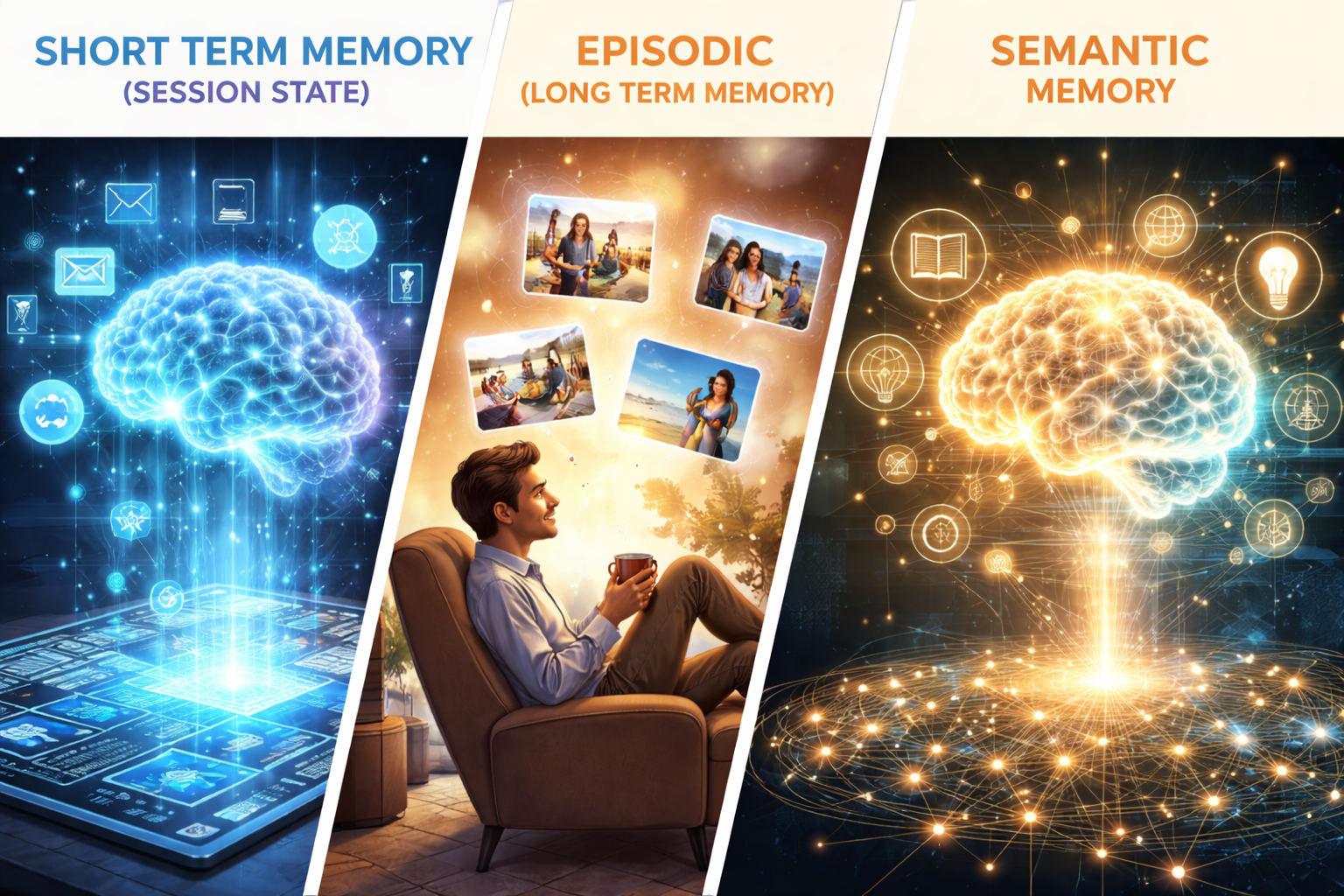
Memory in agentic AI is not a single construct. It is a layered architecture, each type serving a distinct purpose in the decision cycle.
1. Short Term Memory (Session State)
This is the working context of the agent. It holds the immediate state of interaction, including recent inputs, intermediate reasoning steps, and current objectives.
In practical terms, this is what enables an agent to maintain coherence during a session.
- Maintains conversational or task continuity
- Stores reasoning traces and tool outputs
- Resets frequently to avoid drift
- Closely tied to token or context window constraints
Example Use Cases
- Items currently in a shopping basket before checkout
- The last few stock prices seen in a trading app
2. Episodic (Long Term Memory)
This layer captures experiences and persists them over time. It includes structured records of past interactions, decisions, and outcomes, forming a growing body of knowledge that the agent can draw upon.
This is where agents begin to accumulate value rather than simply respond.
- Stores past tasks, interactions, and outcomes as durable events
- Enables recall of similar scenarios across sessions
- Capture user preferences for language, report format, and notification settings
- Supports reflection and longitudinal improvement
- Often implemented using vector stores combined with durable storage layers
Example Use Cases
- A record that a promotion increased sales by 20 percent last Black Friday
- A past fraud alert where a large transaction at midnight was confirmed as suspicious
3. Semantic Memory
Semantic memory represents generalised knowledge. It is not tied to a single event, but rather to facts, rules, and domain understanding.
This is where agents transition from remembering to knowing.
- Encodes domain knowledge and concepts
- Supports reasoning beyond immediate context
- Often sourced from curated datasets or knowledge graphs
- Enables abstraction across multiple experiences
Example Use Cases
- The definition of a “high value customer” based on spend and frequency
- The rule that international transactions carry higher fraud risk than local ones
How Memory Is Typically Stored
The storage layer is where architectural decisions become tangible. Each memory type aligns to different data stores based on access patterns, latency requirements, and structure.
| Memory Type | Typical Storage Mechanism | Characteristics of Storage | Common Enterprise Technologies |
|---|---|---|---|
| Short Term Memory | In memory cache | Ultra low latency, ephemeral, session scoped | Redis Cache, Memcached |
| Episodic (Long Term Memory) | Vector store + durable storage | Semantic retrieval combined with persistence across time | Pinecone, Weaviate, OpenSearch (vector), SQL Server, PostgreSQL |
| Semantic Memory | Document store / knowledge graph | Structured and unstructured knowledge, supports relationships and indexing | Elasticsearch, MongoDB, Neo4j |
There is a certain satisfaction in getting this layer right. When storage aligns with memory type, retrieval becomes predictable and performance follows naturally. When it does not, systems tend to behave like they have misplaced their keys, often at the least convenient moment.
Memory Versus RAG
Retrieval Augmented Generation, often referred to as RAG, plays an important role in modern AI systems. It provides access to external knowledge at the moment of inference. Yet it operates with a fundamentally different purpose compared to agent memory.
RAG focuses on enriching a single response. Memory focuses on shaping behaviour over time.
| Aspect | Agent Memory | RAG (Retrieval Augmented Generation) |
|---|---|---|
| Purpose | Build continuity and learning across interactions | Enhance responses with external knowledge |
| Time Horizon | Persistent across sessions and workflows | Single query or request scope |
| Data Type | Experiences, knowledge, workflows, state | Documents, chunks, embeddings |
| Evolution | Continuously updated and refined | Typically static or periodically refreshed |
| Role in System | Core part of agent reasoning loop | Supporting retrieval layer for context injection |
| Behaviour Impact | Influences decisions, actions, and strategy | Improves factual grounding of outputs |
In practice, the two often work together. Episodic and semantic memory may be implemented using similar technologies as RAG, such as vector stores. The distinction lies in intent and orchestration.
RAG retrieves information. Memory integrates it into the agent’s ongoing state and decision process.
Deciding What to Remember
Designing memory is as much about restraint as it is about capability. The question is not simply what can be stored, but what should be stored.
Data within agent systems carries different lifecycles. Some information is highly transient, relevant only for a single interaction. Other data becomes stale as conditions change. A smaller subset holds long term value and can inform future decisions.
- Transient data should remain in short term memory and expire quickly
- Stale data requires active management, including decay or revalidation
- Expired or outdated knowledge can degrade decision quality if reused
- Sensitive data introduces privacy and regulatory considerations
Privacy becomes particularly important when memory persists across sessions. Personal or sensitive information must be handled with strict controls, including minimisation, anonymisation, and clear retention policies.
Equally, the reuse of stale or contextually incorrect data introduces subtle risks. Decisions may appear consistent while quietly drifting away from reality. This is where governance, lifecycle management, and observability play a crucial role in maintaining trust in the system.
References
Tulving, E. (1972). Episodic and Semantic Memory
Lewis, P. et al. (2020). Retrieval-Augmented Generation for Knowledge-Intensive NLP Tasks
OpenAI (2024–2025). Function Calling, Memory, and Tool Use in LLMs
LangChain / LangGraph (2024–2025). Agent Memory and State Management Documentation