There has been a quiet shift in how we build with large language models. Not long ago, most systems began with a prompt, perhaps a few tools, and a chain stitched together to produce something useful. It worked, often surprisingly well, and for many teams that was enough.
Then systems started to grow. What began as a simple interaction turned into multiple steps, dependencies, retries, and edge cases. At that point, the idea of a chain began to feel slightly optimistic, in the same way a whiteboard sketch sometimes survives longer than it should.
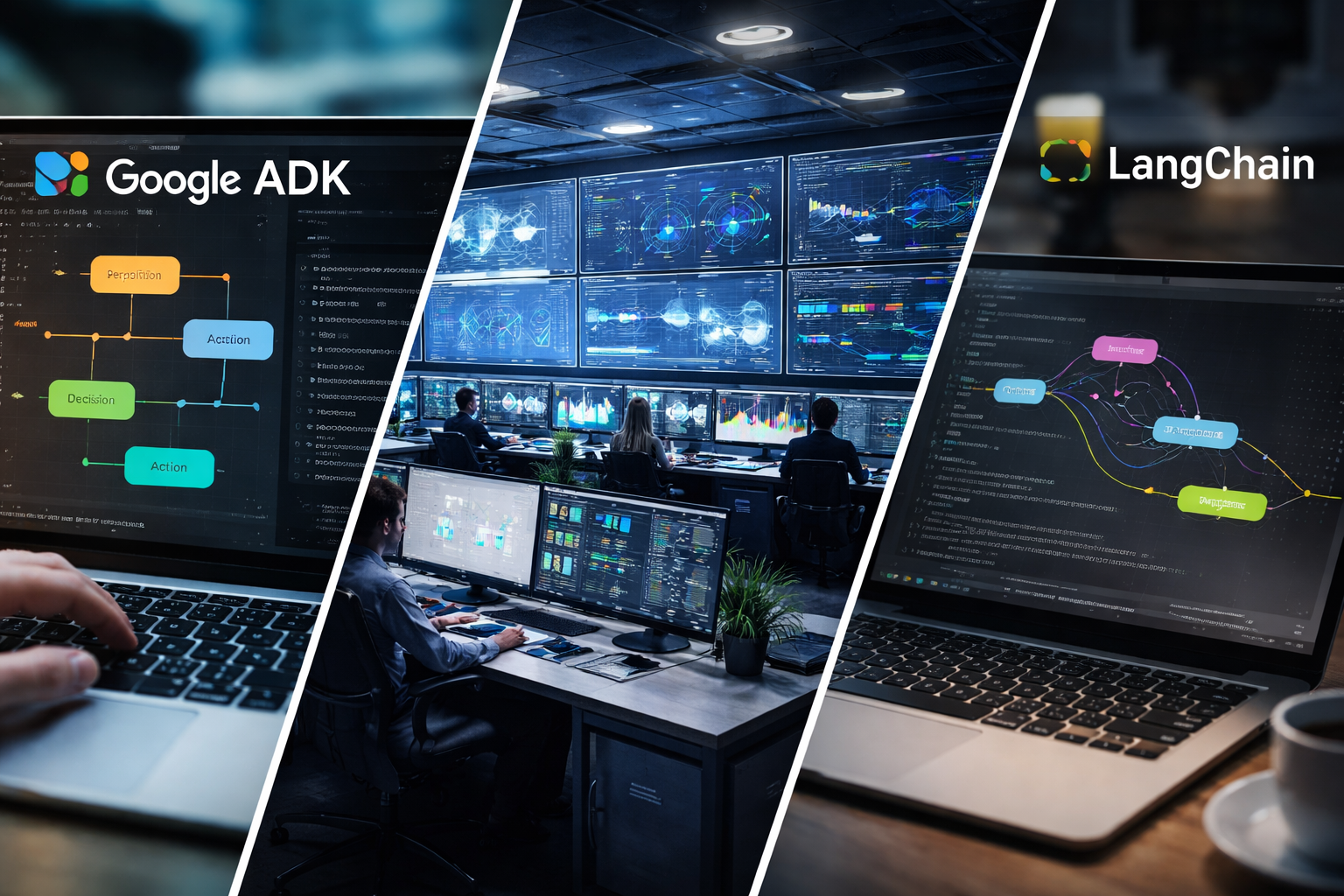
This is where the conversation moves from LangChain to LangGraph, and now to Google’s Agent Development Kit. Each represents a stage in the same evolution.
From Prompts to Systems
LangChain made it possible to connect models to the world. It gave developers a way to integrate tools, retrieval, and reasoning without building everything from scratch. It was, and still is, the fastest way to get something working.
But as systems matured, a pattern emerged. Developers began to reimplement the same ideas repeatedly:
- State management
- Multi step workflows
- Conditional execution
- Error handling and retries
LangGraph appeared as a response to this, bringing structure to orchestration and making execution visible.
Google ADK takes this further by assuming that agents are not experiments but systems that must behave predictably.
Understanding the Stack
Rather than competing frameworks, these tools form a layered stack that reflects increasing maturity.
| Layer | Framework | Purpose |
|---|---|---|
| Components | LangChain | Tools, LLMs, retrieval, integrations |
| Orchestration | LangGraph | State, control flow, execution graphs |
| Agent Runtime | Google ADK | Structured agents, contracts, workflows |
Each layer builds on the one below it, introducing more control and more responsibility.
LangChain: Where Ideas Take Shape
LangChain remains widely used because it optimises for speed and flexibility. It allows developers to quickly connect LLMs to tools and data sources, creating useful applications with minimal overhead.
It offers:
- Rapid prototyping of LLM applications
- Extensive integrations
- Flexible agent patterns
- Minimal upfront structure
This flexibility is often exactly what is needed in early stages, when the goal is discovery rather than control.
LangGraph: Where Control Emerges
LangGraph introduces explicit orchestration. Instead of relying on the model to decide everything, developers define a graph where nodes represent steps and edges define transitions.
This approach brings clarity:
- Execution paths are defined rather than inferred
- State is explicit and inspectable
- Complex workflows become manageable
- Debugging becomes significantly easier
LangGraph does not remove flexibility. It channels it into a form that can be reasoned about.
Google ADK: Where Structure Becomes Non Negotiable
Google ADK builds on similar principles but takes a more opinionated approach. It treats agents as structured components within a broader system, with clear contracts and defined behaviour.
Key characteristics include:
- Strongly typed inputs and outputs
- Explicit agent definitions
- Structured workflows
- A defined runtime model
Where LangGraph provides a graph engine, ADK provides a framework for building consistent, production ready agent systems.
The Architectural Differences
The distinctions between the three approaches become clearer when viewed together.
| Dimension | LangChain | LangGraph | Google ADK |
|---|---|---|---|
| Primary Focus | Integration | Orchestration | Agent architecture |
| Abstraction Level | High level components | Low level control | Structured system design |
| Execution Model | Prompt driven | Graph driven | Workflow driven |
| State Handling | Implicit | Explicit shared state | Structured inputs and outputs |
| Typing | Loose | Optional | Strong emphasis |
| Production Readiness | Requires layering | Requires design | Built with production in mind |
Where Each Fits
LangChain: Early Exploration
LangChain is well suited to early stage development where speed and flexibility matter. It allows teams to test ideas, integrate tools quickly, and understand what works before introducing structure.
LangGraph: Workflow Orchestration
LangGraph becomes valuable when systems require control over execution. It supports complex workflows, branching logic, and stateful interactions that go beyond simple chains.
Google ADK: Production Systems
ADK is designed for production environments where reliability, governance, and maintainability are required. It enforces structure and aligns with established engineering practices.
The Direction of Travel
What is emerging is a layered engineering model for agents:
- LangChain lowers the barrier to entry
- LangGraph introduces control and visibility
- ADK enforces structure and consistency
Each stage reflects increasing maturity in how systems are designed and operated.
There is also a moment many teams recognise. A system that began as a simple chain becomes increasingly complex, with hidden state and unpredictable behaviour. Introducing structure tends to resolve this quickly, even if it requires revisiting earlier decisions.
References
- Google Agent Development Kit Documentation — https://google.github.io/adk-docs/
- LangChain Documentation — https://python.langchain.com
- LangGraph Documentation — https://langchain-ai.github.io/langgraph/